
Summer 2025 Weather Outlook: Data Centers & ERCOT Guidance

Note: this article was first published in our June 2025 Monthly Journal.
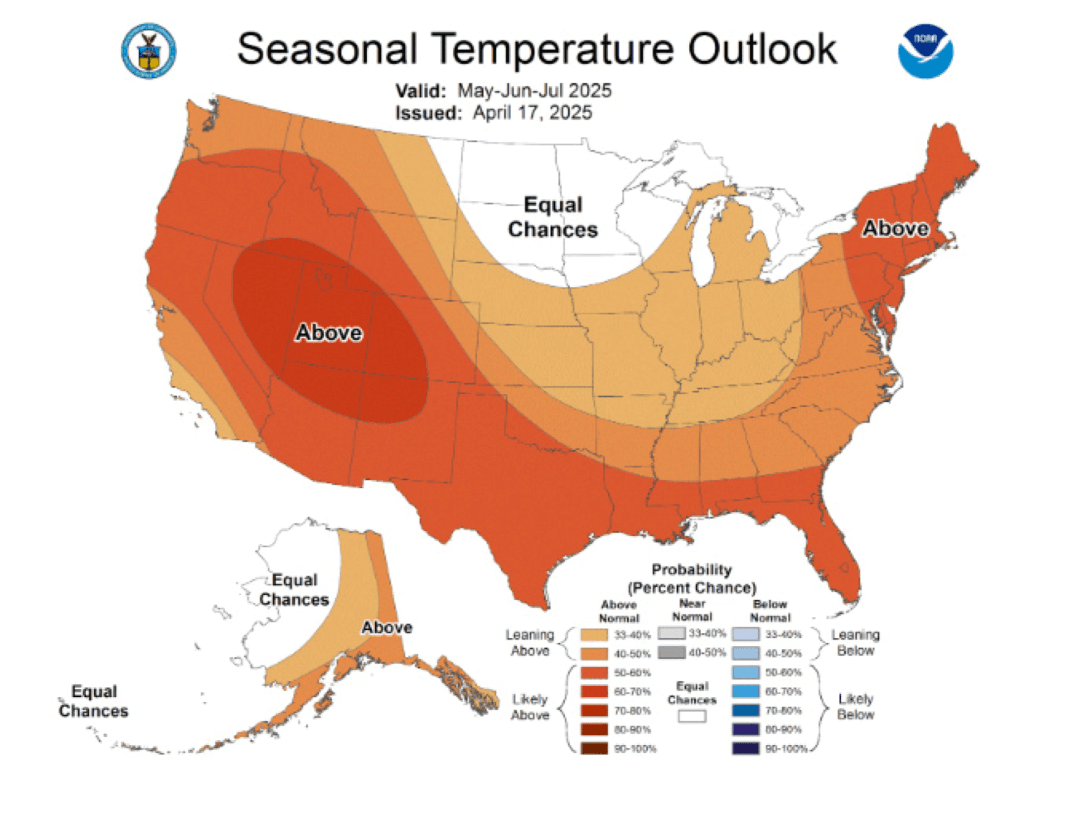
According to the National Weather Service, the May‑June‑July temperature outlook favors above normal heat across most of the United States for this upcoming summer. After three consecutive La Nina years, the Pacific Ocean has shifted to favoring ENSO‑neutral conditions which typically leads to reduced predictability in seasonal forecasts without the strong guidance of El Nino or La Nina conditions. Taking into account local conditions and the global warming trend, the NWS forecasts a high likelihood of above‑normal temperatures for a large swath of the Lower 48 that spans from the Northeast and extends down to Florida, Texas, and wholly covers the American West. This heat footprint is partially attributed to lingering drought conditions in the West & Central states which amplifies high temperatures.
Globally, 2025 is expected to be one of the warmest years on record even without an El Nino boost and is expected to finish only slightly behind 2024 in terms of global daily average temperature. The risks of heat waves are elevated with the potential for extended “heat dome” high pressure systems to cover large portions of the US as seen in recent years. In addition to heat wave risk, ENSO‑neutral conditions still favor a higher incidence rate of hurricanes than during El Nino, though not as much as La Nina. In short, the natural gas industry is set to face a summer of significant cooling demand combined with a non‑negligible hurricane risk which could affect LNG export facilities in the late summer.
Data Centers Under Extreme Heat
Data centers, which require massive and constant electricity for both computing and cooling, will likely play a large factor in peak electricity demand this summer especially as most data centers are concentrated in California, Texas, and Virginia–all regions that are highly likely to experience above‑normal temperatures .While most data center projects announced recently will not be online until the late 2020s or early 2030s, many new data centers and Bitcoin mining facilities that were in planning several years ago are now coming online, adding demand that runs 24/7. During heat waves, natural gas fired power plants will likely carry a large share of the burden to meet peak loads, especially during late afternoon when renewable output wanes and demand peaks.
Based on data and projections from 2023 and 2024, data centers may have added roughly 6 GW of continuous demand just in 2024, pushing yearly projected data center daily power consumption in 2025 to 23‑26 GW compared to 20 GW in 2023. As of March 2025, there were roughly 5,500 data centers in the US compared to only 1,000 in 2018. Cooling equipment constitutes about 40% of an average data center’s energy consumption. However, AI‑centric data centers, which consti tute roughly 70% of new data center build outs, have much higher bars for cooling and electricity consumption than average data centers due to much higher densities of equipment and can reach multiple times the cooling & power demand of conventional centers. As such, the EIA expects 2025 to reach a record 4,205 TWh demand, breaking last year’s 4,097 TWh. More concretely, the EIA’s forecast on wholesale electricity price at the ERCOT North Hub operates on a base case that shows equal or slightly higher prices in July 2025 as compared to last summer’s prices.
NERC have issued warnings in its 2024 long‑term assessment, citing “increasing large load demand from data centers and Bitcoin operators” as a primary driver of rising reliability risk in ERCOT, and indeed, ERCOT’s own modeling shows that by 2026‑2028, expected unserved energy could rise if no new capacity is added beyond planned due to this surge in large loads. To hedge against this, Texas is exploring new fast‑start gas generators to maintain reliability as well as signing agreements with data center operators to implement power curtailing during unusually high‑demand periods to reduce grid stress. Still, ERCOT has described data center growth as being non‑dispatchable loads that could increase tail‑risk of outages during abnormal conditions, despite mitigation efforts.
While mitigation efforts are currently being implemented on large scales across the nation, the nature of the Big Tech hyperscalers means that data center growth is being driven at an unprec edented pace. A grid stress scenario this summer will almost certainly involve data centers, particularly the cooling demand that is still an uncertain piece of the puzzle. Current forecasts have operated on the assumption that consumers will be able to draw less power when it becomes uneconomical. However, a tail‑risk scenario may involve a situation in which data‑center operators and businesses simply cannot afford to power down.
Keep Reading
More from Gelber & Associates


European Natural Gas Storage and Winter Weather Expectations
European natural gas storage is in a solid position but behind the exceptional pace of recent years. As of early August, EU storage stands near 70% full, well below the ~90% reached at this time in 2024 and 2023.

Sections 278 & 279 Could Fuel Demand
Trump’s “One Big, Beautiful Bill” (H.R. 1) is a roughly 1,000-page budget-reconciliation omnibus that the House passed 215-214 towards the end of May.